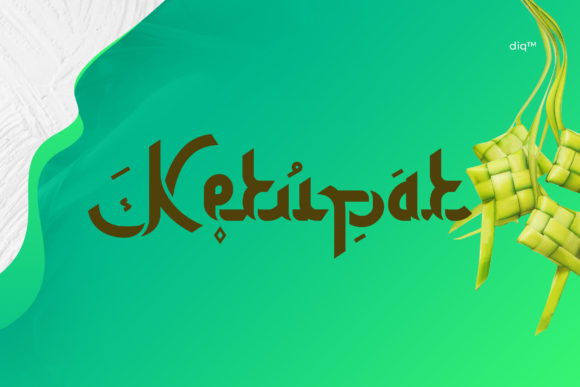
Ketupat: A Beautiful Arabic-Style Display Font for Handmade Creators
As someone who handcrafts greeting cards, prints boutique labels, and designs seasonal SVG bundles for Cricut and Silhouette users, I’m always hunting for display fonts that do more than just look pretty—they need to work. Ketupat is one of those rare finds: a clean, elegant Arabic-inspired display font that balances visual richness with real-world usability. It’s not overly ornate, but it carries warmth, intention, and quiet sophistication—exactly what my customers respond to when they see handmade packaging or wedding welcome boards.
Ketupat’s charm lies in its subtle geometry and graceful curves. Think of it as the kind of typeface you’d choose for a small-batch candle label where “Lavender & Sandalwood” needs to feel luxurious but still legible at 12mm height—or for a rustic farmhouse sign where “Gather Here” deserves presence without shouting. Its Arabic styling isn’t literal calligraphy, but rather an inspired reinterpretation: refined strokes, balanced spacing, and a rhythm that feels both timeless and contemporary.
I use Ketupat most often for short, high-impact phrases—product names, event titles, shop signage, and decorative headers on printable planner pages. It shines in physical product applications: heat-transfer vinyl on linen tote bags, foil-stamped gift tags, engraved wooden coasters, and die-cut sticker sheets. Because it’s PUA encoded, every alternate glyph, ligature, and stylistic flourish is accessible directly from your keyboard—no complex OpenType panels needed. That means less time troubleshooting software and more time designing.
Readability matters—especially when cutting vinyl or printing tiny labels. Ketupat holds up beautifully at sizes as small as 8pt on matte-finish product tags, and scales cleanly to 300pt for wall art prints. For Cricut users: test your cut settings on scrap cardstock first—its fine details (like tapered terminals and delicate joins) respond best to medium blade pressure and slower speeds. On printed invitations or greeting cards, Ketupat reads clearly even in soft ink colors like sage green or dusty rose, thanks to its strong contrast and open counters.
Here’s where Ketupat fits in my workflow:
- Candle & soap labels: Paired with a light sans serif for ingredients (think Montserrat Light), Ketupat adds artisanal credibility to apothecary-style packaging.
- Wedding stationery: Used for couple names on save-the-dates or “Welcome” on chalkboard-style welcome signs—it conveys elegance without formality.
- Digital printables: I’ve built a set of Ramadan-themed planner stickers using Ketupat for key phrases like “Intention” and “Gratitude”—its Arabic roots make it culturally resonant while remaining universally appealing.
- Seasonal SVG bundles: For holiday markets, I layer Ketupat over hand-drawn wreaths or minimalist snowflakes—it elevates festive designs without competing visually.
- Boutique tags & hang tags: Small batch jewelry makers love how Ketupat gives their brand a signature touch—even on 1.5-inch kraft paper tags.
Font pairing is where Ketupat really sings. Because it’s expressive but restrained, it pairs effortlessly with grounded, functional companions. Try it with a warm serif like Playfair Display for body text on invitation suites, or a friendly sans like Quicksand for social media graphics. If you’re designing digital templates for Canva or Adobe Express, pair Ketupat with a clean monospace for dates or pricing—it creates instant hierarchy and visual breathing room.
Ketupat is strictly a display font—not meant for paragraphs or long-form text—but that’s exactly why it works so well for creators. We don’t need paragraph fonts. We need standout typefaces that anchor our brand voice in a single word: “Handmade.” “Bloom.” “Hearth.” “Sol.” Ketupat delivers that weight and character, consistently.
It comes in a single, highly refined style—no bold or italic variants—but that’s intentional. Its strength is in its singularity: one carefully crafted weight, rich with alternates and contextual ligatures. You’ll find swash capitals, dotted diacritics, and thoughtful punctuation that subtly nods to Arabic typographic tradition—all accessible via PUA encoding in design apps like Affinity Designer, Illustrator, and even newer versions of Cricut Design Space.
Licensing is straightforward—and critical for sellers. Ketupat includes a commercial license that covers physical products (stickers, mugs, apparel), digital downloads (printables, SVG files, Canva templates), and client work. No extra fees for Etsy listings or Shopify storefronts. Just be sure to embed fonts in PDFs or rasterize them for SVG exports—standard best practice for protecting your assets and ensuring consistent rendering across devices.
What sets Ketupat apart isn’t just its beauty—it’s how quietly capable it is. It doesn’t demand attention; it earns it. When a customer picks up your lavender soap and lingers on the label, or pins your printable quote to their vision board, that pause is Ketupat doing its job: making handmade feel intentional, meaningful, and unmistakably yours.